
 Global Design Services
Hilton's Global Design Services team — the architects, designers, and project managers behind hotel renovations, new builds, and brand standards across the portfolio — came to the table with a clear aspiration: more time for creative work, stronger presence at industry events and with clients, and deeper relationships with owners and consultants.
Discovery and a full landscape audit of how the hospitality and design industry is using AI — followed by a structured engagement covering use case ideation, a prioritization workshop, workflow reimagining exercises, and roadmap planning. Data readiness, platform evaluation, implementation guidance, and KPIs built in throughout.

 Marketing Team
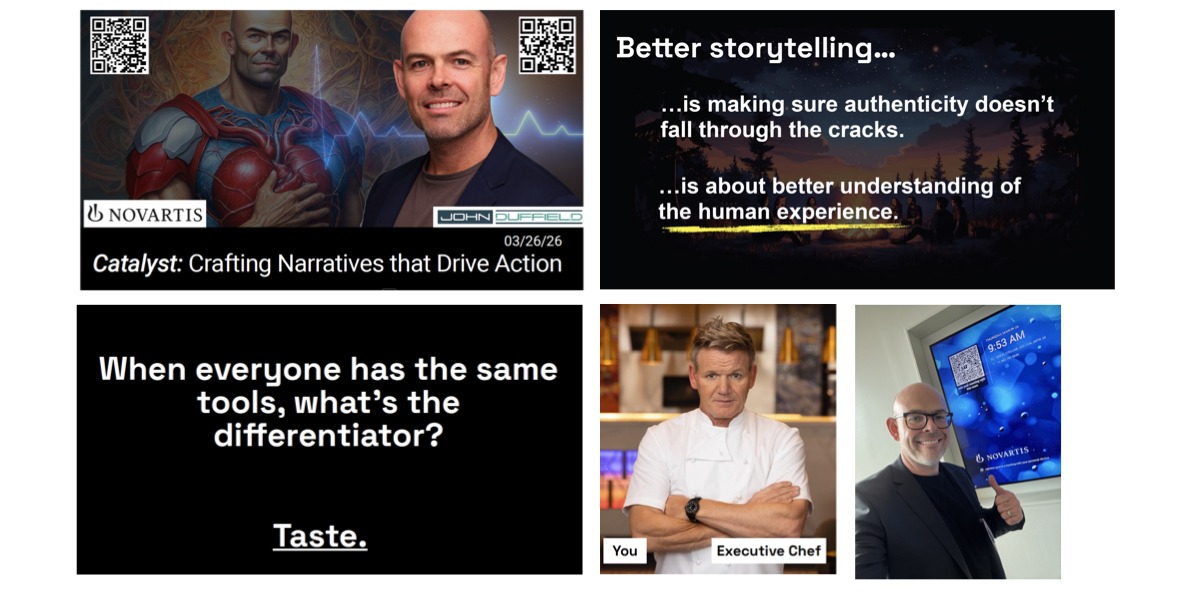
Facilitated sessions with Novartis marketing teams on storytelling as a repeatable strategic capability — how to translate sophisticated strategy and data-driven insight into narratives that build alignment and drive action across a large organization. Deliverables included narrative frameworks for storytelling in the AI era: practical tools for communicating strategy, change, and possibility in a moment when people need a story they can believe in.
The ability to communicate strategy clearly and compellingly is a critical and often overlooked component of organizational AI adoption. Teams that can articulate the why, the what, and the path forward are the ones that bring people with them through transformation.
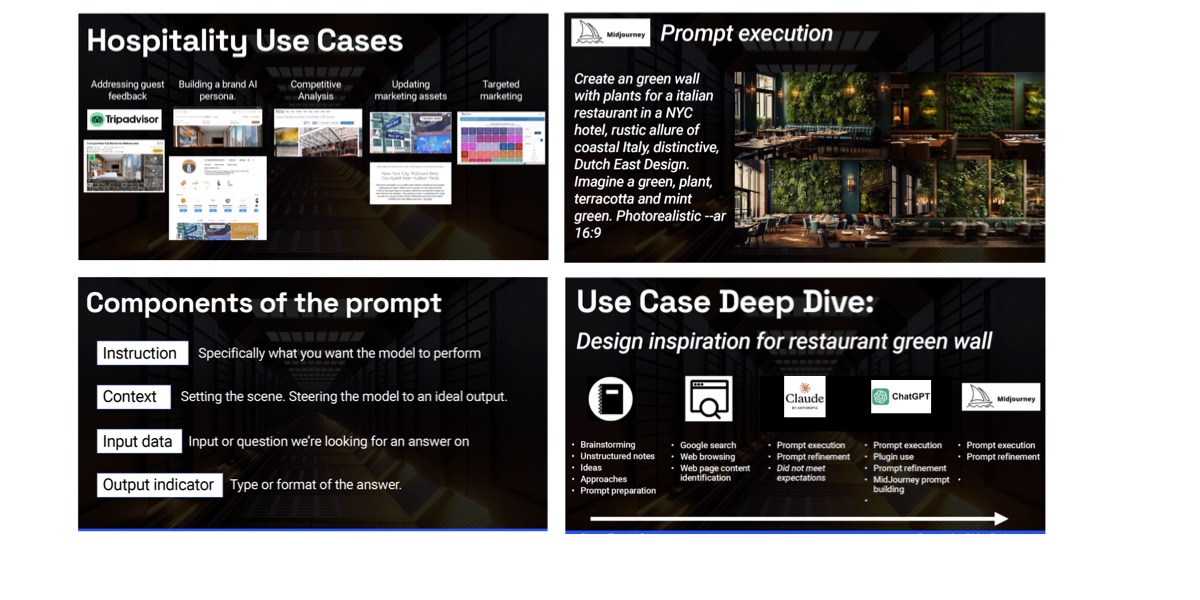
A multi-property operator working within a franchise system, at the beginning of their AI journey — not hesitant, energized. The engagement opened with AI fundamentals: introduction to AI, the anatomy of prompting, and deep workflow immersion across the business to surface the highest-value opportunities.
A use case deep dive identified an immediate high-impact opportunity: AI adopted directly into the architectural design process at the property level. Using contextually relevant, on-brand prompting, the time to develop a creative brief for complex design work was fundamentally transformed.
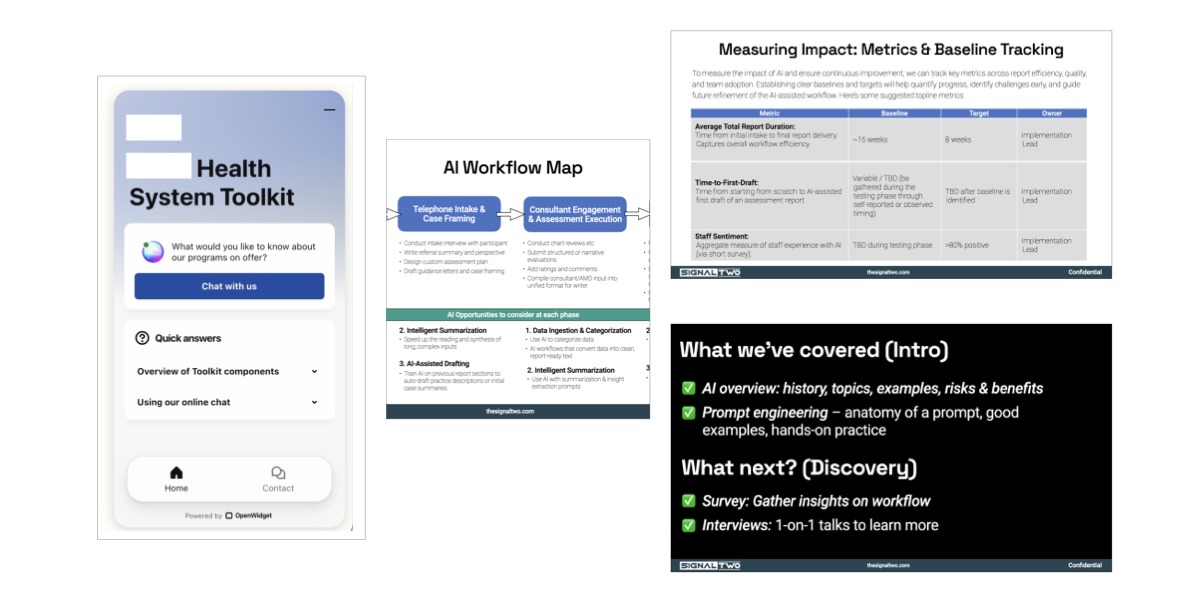
A clinical organization running a high-volume physician assessment and medical licensing program. Operating in a highly regulated environment, governance and compliance consultation was foundational from day one. The intake, assessment, and report writing process is highly manual — demanding significant staff time at every stage.
A full AI transformation engagement: AI fundamentals and prompt writing workshops, stakeholder interviews, workflow immersion, compliant model evaluation and selection, prototype development, workflow mapping, and a measurement plan. Building the foundation for AI-assisted operations from first principles.
A private company in the public education sector, where every sales conversation kicked off the same trail of manual work: review the recording, write up the notes, tailor the pitch, draft a proposal, and update the CRM by hand. Each step took time — and usually waited until someone surfaced from their next meeting to do it.
We built a set of AI-assisted automations that fire the moment a meeting is recorded. A shared foundation transcribes each qualifying conversation, then branches three ways — tailoring the pitch and assigning the follow-up, generating a finished proposal from a template, and logging a structured note straight onto the deal. The building blocks — AI passes, code steps, task creation, document generation, CRM writes — are a kit that mixes and matches to any workflow. A separate daily engine even scans the morning's education news and drafts publish-ready articles in the team's own voice.
The first conversation is 30 minutes. No pitch deck. No pressure. Just an honest look at where you are and whether Signal Two is the right fit.